Key facts
- The Staunton pattern, the standard shape of tournament chess pieces, was registered in London by Nathaniel Cooke in March 1849, made by the firm of John Jaques and introduced to the public that September (World Chess Hall of Fame).
- FIDE's equipment standard in force since 1 March 2026 sets a 95 mm king, squares of 5 to 6 cm and four pawns fitting on one square (FIDE Handbook C.02).
- FIDE asks for a matte, non-reflective finish on pieces and board, and felt or a similar silent, skid-proof material under every piece (FIDE Handbook C.02).
- A 1946 Man Ray chess set sold at Christie's for £38,750 in February 2016, and an Isamu Noguchi chess table sold at Phillips for $325,000 (Christie's, Phillips).
- A Lewis Chessmen warder bought for £5 in 1964 sold at Sotheby's for £735,000 in July 2019 (Chess.com, ChessBase).
Luxury chess sets are defined less by price than by four things you can check with your hands: the wood, the carving of the knight, the weight inside each piece and the proportion between pieces and board. The shape almost all of them follow was registered in London on 1 March 1849, and FIDE still asks for a king of 95 mm on squares of 5 to 6 cm. This guide covers the materials, the makers collectors know, what sets fetch at auction, and how to choose and keep one for play, for a shelf or as a gift.
What makes luxury chess sets different
A luxury set is one where the maker spent money where your hand and eye will notice. Most of it goes into the knight, the only piece that has to be carved by hand, and the rest into the wood, the weighting, the finish and what sits under each base. Ebony, the classic dark wood, is rarer and dearer than the rosewoods often used in its place.
Price on its own tells you little. A set can be expensive because of a logo, a casket or a famous owner and still play badly: a king that wobbles, pieces that crowd the squares, a glossy board that throws the lamp back at you. The sections below give you the checks that separate the two.
Woods, stone, metal and crystal: the materials of luxury chess sets
Wood is the default, and for play it is still the right one. The classic pairing is boxwood for the light pieces and ebony for the dark, the combination of the first Staunton sets of 1849. Boxwood is dense and fine-grained and ages well, rosewood carves cleanly and takes a deep polish, and ebony is so rare and costly that it usually appears only on expensive sets. Boards add maple, walnut and burl.
Read the label for one word: ebonized. An ebonized piece is boxwood stained black. New, it is hard to tell from ebony, but the stain can wear off on edges and details over the years. Genuine ebony costs more and needs no stain.
Stone, metal and glass are older than they look, and they belong mostly to display. The Met holds a rock-crystal chess or backgammon piece, 2.5 cm high, dated to the 10th to 11th century or later. A silver-gilt and enamelled set by Elkington & Co., with marks for 1866, was offered by Christie's in its Exceptional Sale of 2014. Such sets are spectacular on a sideboard. For a long game, FIDE's rules ask for wooden or plastic pieces with a matte, non-reflective finish, and polished crystal and stone reflect light by nature.
Hand carving, weighting and felt
The knight is where you look first, because it is the one piece that has to be carved. Kings, queens, bishops, rooks and pawns are turned on a lathe, so look at how crisp the turnings are, how even the finish is and whether every piece of one kind matches the others. On a fine knight the mane, eyes and mouth are cut cleanly on both sides, and the two knights of one colour match without looking like copies of a mould.
Weight is the second test. A metal weight is set into the base so the piece lands quietly and stays where you put it: pick up a king, and it should feel heavier than its size suggests. The finest sets glide on leather bases instead of felt, which is smoother and quieter on a polished board.
FIDE's version of the same idea is plainer. Its equipment standard says the underside of each piece should carry felt pads or a similar silent, skid-proof material, and the board should have the same underneath.
The Staunton pattern since 1849
The Staunton pattern is the standard shape of tournament chess pieces: a king topped by a crown, a queen by a coronet, a knight carved as a horse's head. According to the World Chess Hall of Fame, the pattern was registered in March 1849 by Nathaniel Cooke, made by the firm of John Jaques of London and introduced to the public in September 1849.
The name came from Howard Staunton, the most prominent player of the time, who lent the set his endorsement and promoted it in his newspaper column. Who actually drew the pieces is still argued over, between Cooke, who registered the design, and the Jaques workshop that made it.
The pattern won because it plays well. The bases are broad and weighted, each piece reads at a glance, and the World Chess Hall of Fame notes that it became the only design allowed in major tournaments starting in the 1920s. FIDE's 2026 rules still call for the Staunton style.
Board size and king height: the FIDE numbers
For a set you will play on, proportion matters more than material. FIDE's standard for chess equipment without electronic components, in force since 1 March 2026, gives these figures:
- King 95 mm high, then queen 85, bishop 70, knight 60, rook 55 and pawn 50 mm, with up to 10% variance if the order holds.
- The base of each piece between 40% and 50% of its height.
- Squares of 5 to 6 cm a side, with four pawns fitting comfortably on one square.
- A matte or otherwise non-reflective finish on both board and pieces.
- A board of natural wood, such as birch, maple or ash with walnut, teak or beech, and tables for FIDE-run competitions of about 110 by 85 cm and 74 cm high.
A working rule follows from those numbers. FIDE's 95 mm king on 5 to 6 cm squares puts the square at 53% to 63% of the king's height, so measure the king, take a little under 60% of its height, and that is your square: a 10 cm king wants a square near 5.8 cm. A large set on a small board looks crowded and plays worse, because pieces get knocked as you reach across.
The makers collectors know
John Jaques of London made the first Staunton sets in 1849, and early Jaques sets are the ones collectors look for. The white king is stamped with the maker's name, and on the best sets a rook and a knight of each colour carry a small crown stamp. Those marks matter if you ever sell, because a set without them is priced as an anonymous Staunton.
Silversmiths made the showpieces. Elkington & Co. of Birmingham built the silver-gilt set above, on an ebony and ivory table, for the 1867 Paris Exhibition, and sets like it were made to be looked at more than played.
Fashion and jewellery houses still make chess sets, mostly as objects for a library or a yacht: leather boxes, monogrammed cases, lacquer and precious metal. There you pay for the case and the name as much as for the chess, so judge them by the display rules below rather than the play rules above.
What luxury chess sets fetch at auction
The highest prices go to history and to artists, not to new craft. A single Lewis Chessmen warder (the rook of a walrus-ivory hoard from the late 12th or early 13th century, found on the Isle of Lewis in 1831) was bought for £5 in 1964 and sold at Sotheby's in July 2019 for £735,000, as Chess.com reported. It is 8.8 cm high. Of the original hoard, 82 pieces are in the British Museum and 11 in the National Museum of Scotland, according to ChessBase.
Artists' sets are the other market. Man Ray designed his first chess set in 1920 and reduced the pieces to geometry: a pyramid for the king, a cone for the queen, a cube for the rook, a sphere for the pawn. A wooden set of 1946, number 3 of a small edition, with a 9 cm king on a 44.4 cm board, sold at Christie's on 3 February 2016 for £38,750 against an estimate of £20,000 to £30,000.
Isamu Noguchi designed his chess table in 1944 for The Imagery of Chess, the exhibition organised by Marcel Duchamp and Max Ernst at Julien Levy's gallery in Midtown Manhattan. Herman Miller produced it from 1947 until 1949 in ebonized plywood, with a cast aluminium tray and acrylic inlays in place of squares. One sold at Phillips for $325,000 against an estimate of $150,000 to $250,000. The lesson for a buyer is simple: buy a new set to use it, not to resell it.
How to choose a luxury chess set for display, play or a gift
For play. Choose the Staunton pattern in wood, a king between about 8.5 and 10.5 cm, squares of 5 to 6 cm, weighted pieces with felt or leather underneath and a matte finish. Four queens save you from turning a rook upside down when a pawn promotes. If you want to try good sets before you buy one, our guide to chess clubs in Dubai lists where to play.
For display. Material and colour are free here: stone, crystal, lacquer, resin. Proportion still matters, because a set out of scale looks wrong even to people who do not play. A display case keeps out dust and humidity while the set stays on view.
For a gift. Choose a smaller king, a set that arrives complete with board and box, and colours that suit the room it will live in. Check what is included before you pay: many of the best chessmen are sold without a board.
How to care for a luxury chess set
Wood needs little care and the wrong care ruins it. Wipe the pieces after each use with a soft cotton cloth, dust the board with a non-abrasive microfibre cloth, and use a soft brush for carved details such as the knight's mane.
Wax sparingly, about once a year or less, with a good paste wax on the handled areas only, and buff it off within 15 to 30 minutes. Never use oil on wooden chessmen: it darkens the finish and can turn it gummy. For marks, a damp cloth with a very mild detergent, then dry at once; regular washing damages polished and lacquered pieces.
Keep the set out of direct sunlight, which darkens wood, and away from heat and damp, which make it shrink, swell and warp. Never store the board under heavy objects. For resin, stone or glass, a dry microfibre cloth and no harsh chemicals cover most needs; ask the maker for its own care note.
FERZ handmade boards by Nastya Bers
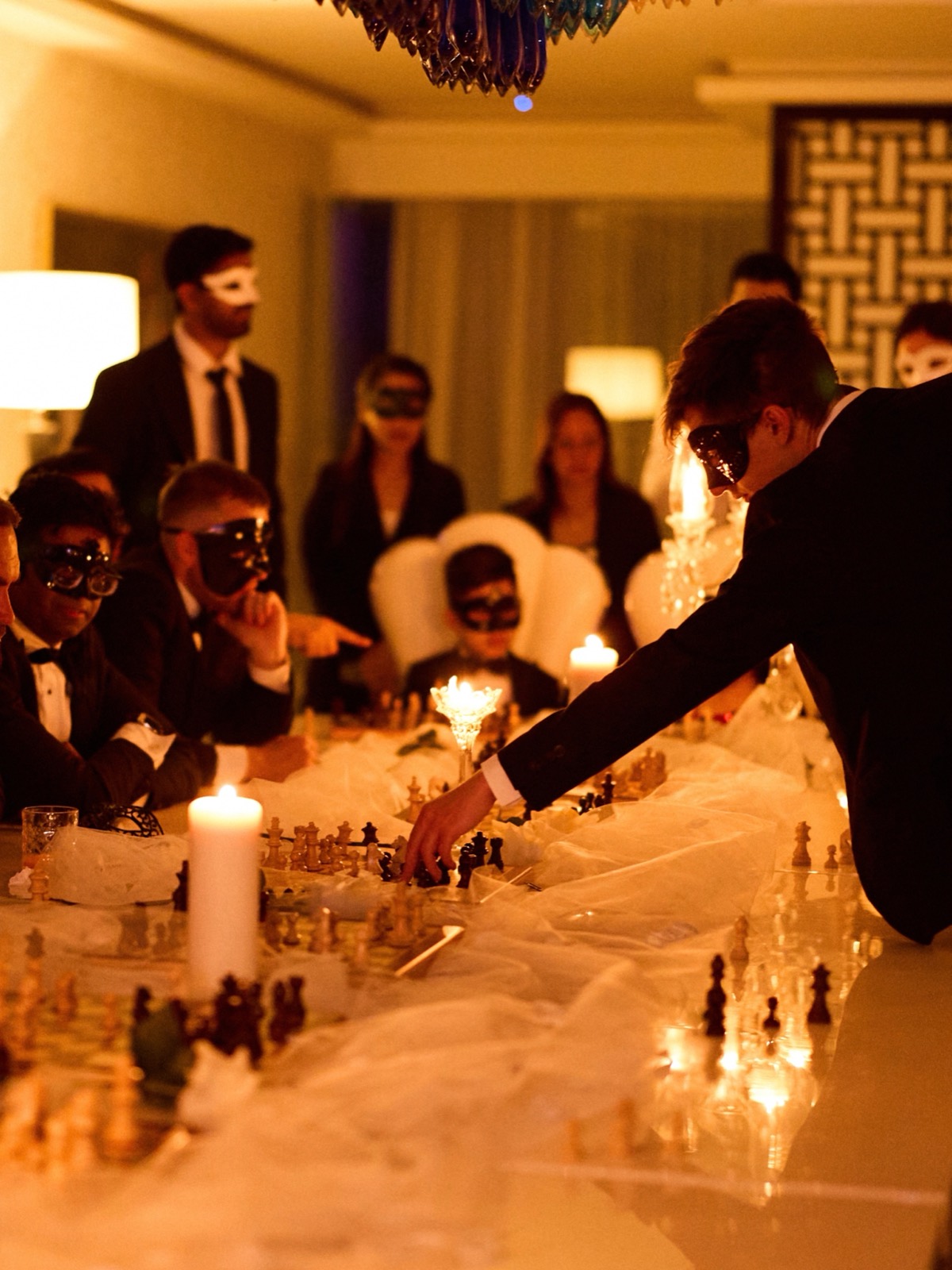
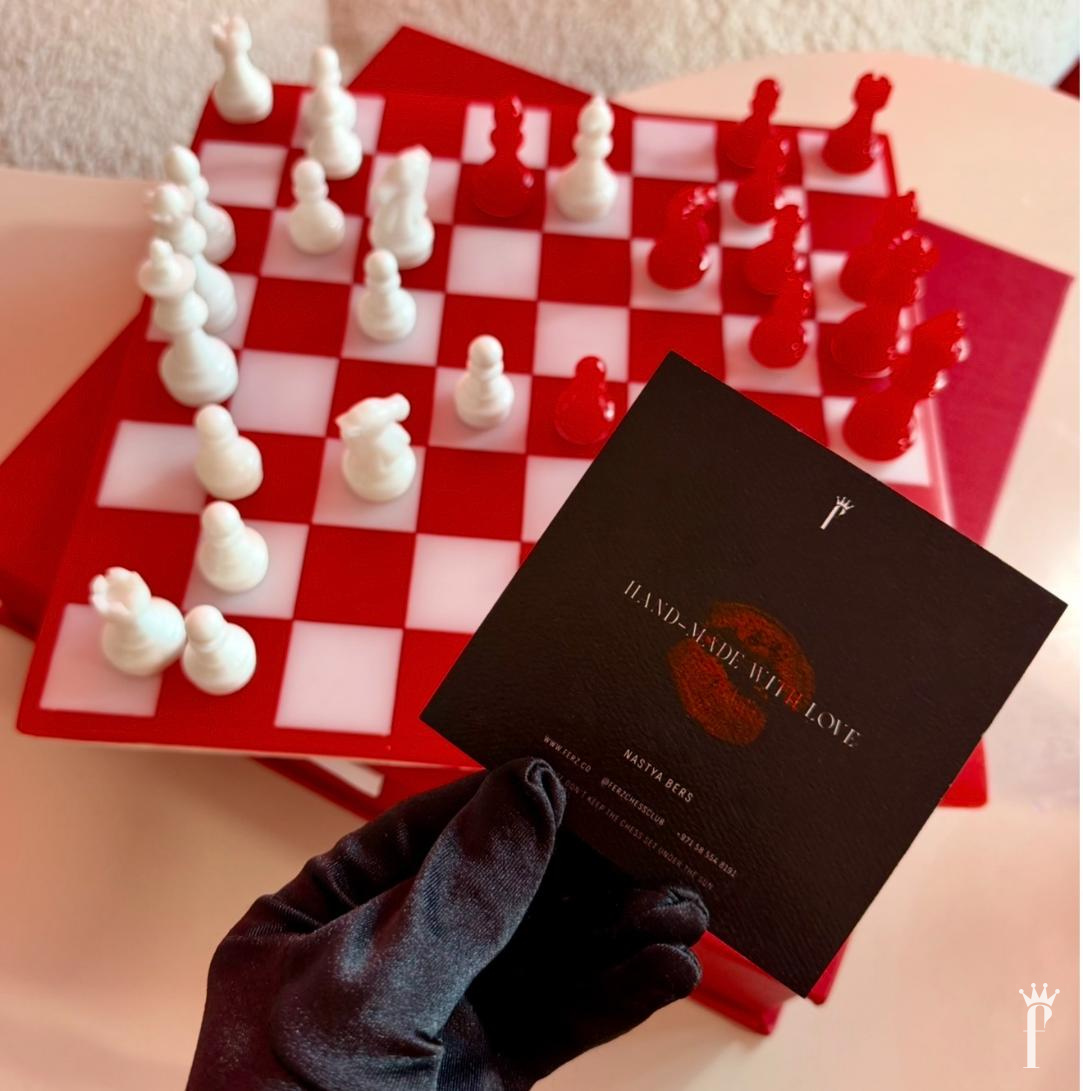
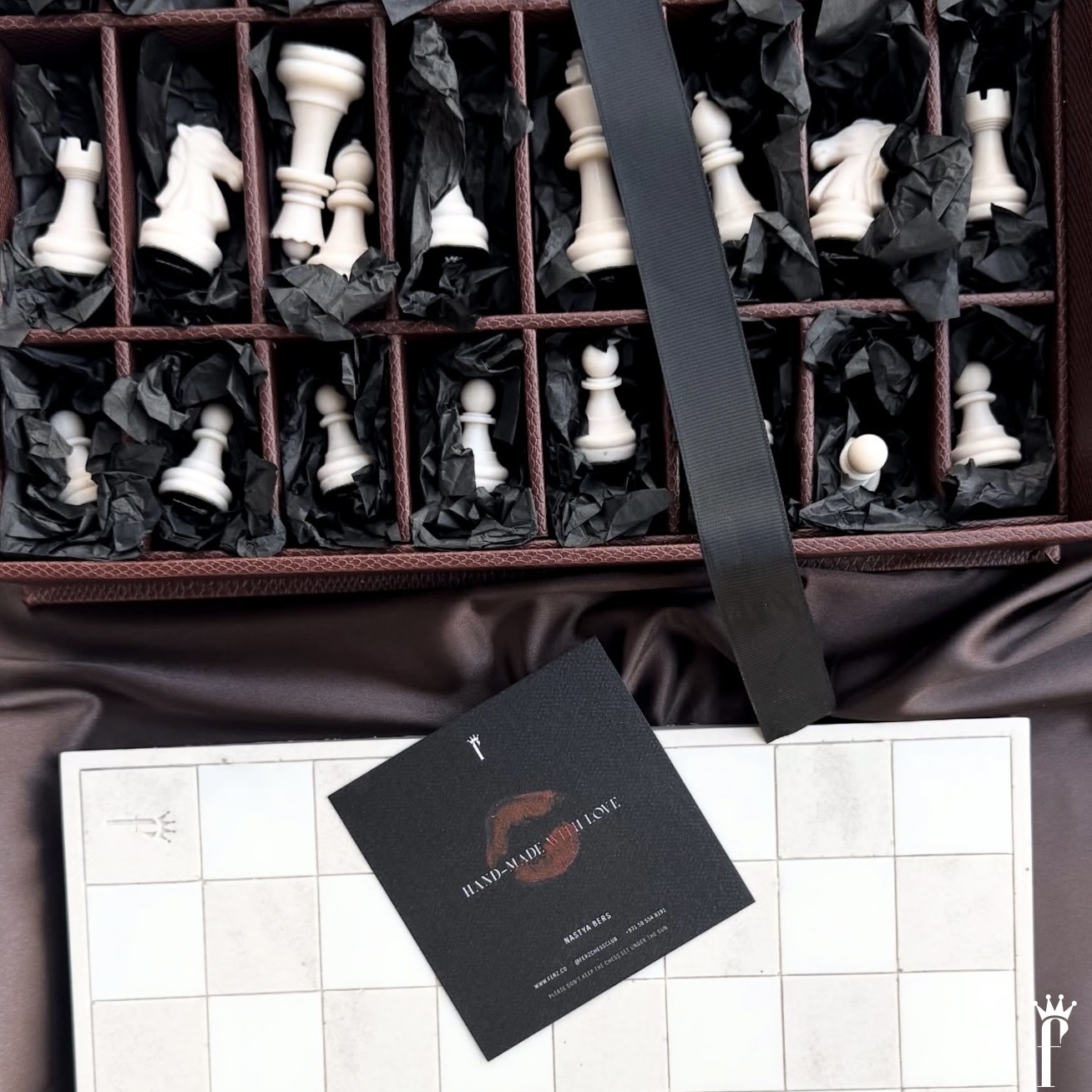
FERZ, a social and chess club in Dubai for lovers of chess and the arts, sells boards made by hand by Nastya Bers, the artist who founded the club. They are not tournament Staunton sets and do not try to be: they are made for a coffee table, a gift or a game after dinner, and the same boards are on the tables at FERZ Chess Nights. Prices are from the FERZ shop on 16 November 2026, and every board can be made to order in your own colours, or as a co-branded edition for a company.

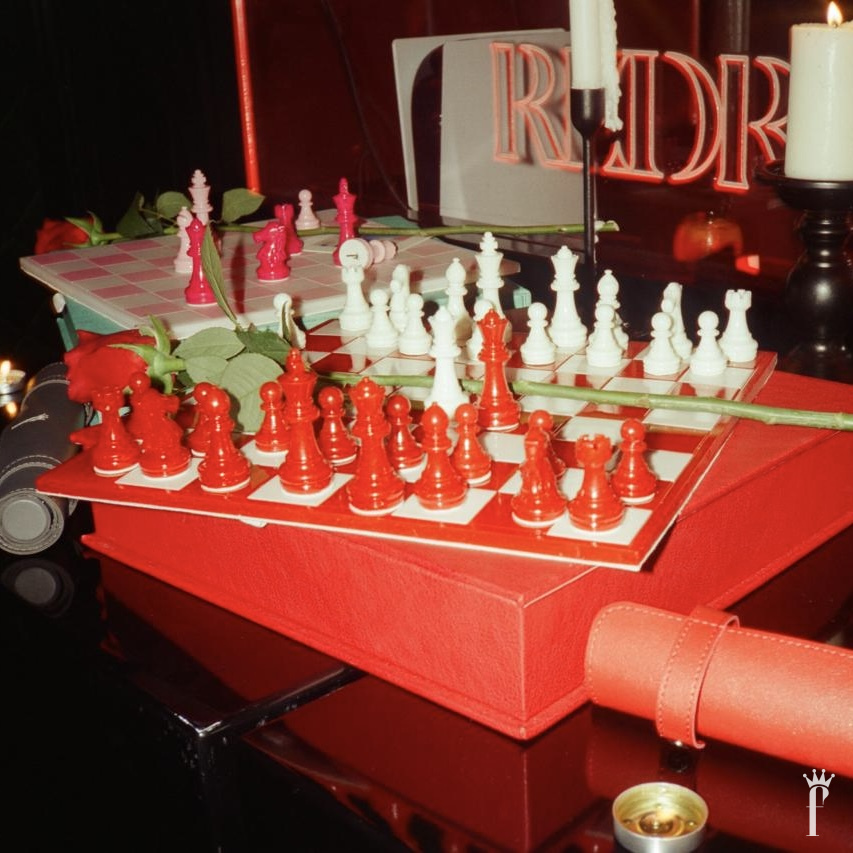
Handmade Chess Set, red and white
The club's own colours. The red and white set has a resin board and resin pieces, a 32 by 32 cm board, a 7 cm king and a faux-leather box of 34 by 34 by 6 cm. A 32 cm board gives squares of at most 4 cm, a little under 60% of the 7 cm king, so the proportion rule above holds at a smaller scale. 950 AED, down from 1,200.
Handmade Chess Set, pink
The same size and box, with the board and pieces in pink epoxy resin coloured with oil-based pigment and finished with a matte varnish, the finish FIDE also asks for on tournament boards. 950 AED, down from 1,200.
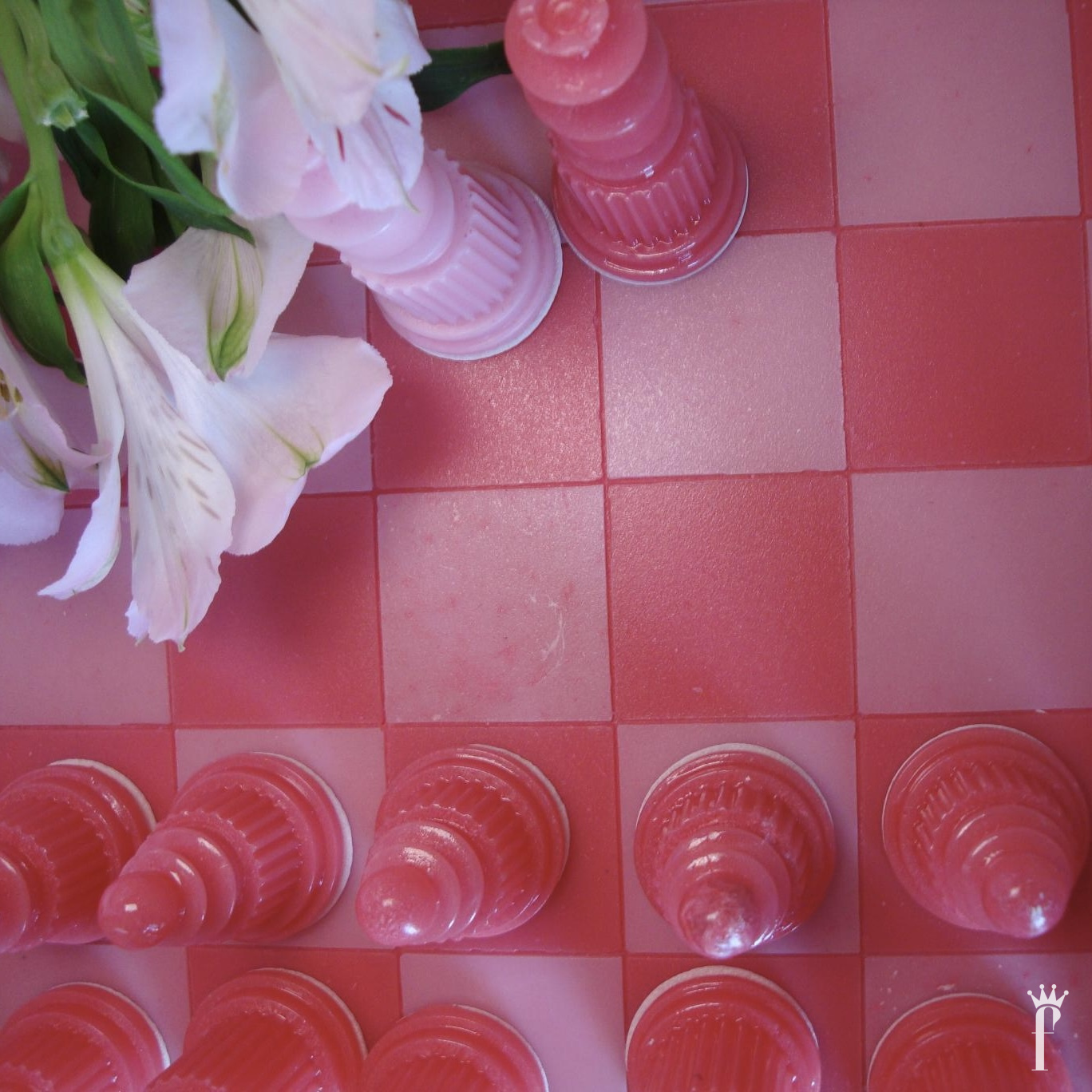
Limited Magnetic Chess Set
The Limited Magnetic Chess Set is epoxy resin coloured with oil-based pigment and made one at a time, so no two are alike. The pieces are magnetic with a weighted feel, and the set has four queens. 1,200 AED, down from 1,500.

Travel Chess Sets, red and gray
For a flight, a beach or a yacht, the Travel Chess Set is a faux-leather board of 22 by 22 cm with flat plastic pieces of about 1 cm, in red or in gray. 289 AED, down from 350.


A checklist for choosing a luxury chess set
- Decide whether the set is for play, display or a gift before you compare prices.
- Measure the king and a square: the square should be a little under 60% of the king's height, and four pawns should fit on it.
- Pick up a knight and check the carving of the mane, eyes and mouth on both sides.
- Weigh a piece in your hand and look for felt or leather under every base.
- Ask whether the dark pieces are genuine ebony or ebonized boxwood.
- Check what is included: board, box, four queens, a maker's stamp or certificate.
- Plan where the set will live: out of direct sun, away from damp, in its box or a display case.
Sources
- Chess Equipment without Electronic Components (C.02, effective 1 March 2026), FIDE Handbook
- The Staunton Standard: Evolution of the Modern Chess Set, World Chess Hall of Fame
- Man Ray, Chess set, lot 360, Impressionist & Modern Art Day Sale, Christie's
- Elkington & Co. chess-table with chess-set designed by Albert Willms, The Exceptional Sale 2014, Christie's
- Isamu Noguchi, Rare chess table, model no. IN-61, Phillips
- Ancient Chess Piece Bought For £5, Sold For £735,000, Chess.com
- Newly discovered Lewis chess piece sold for GBP £735,000, ChessBase
- Chess Piece, Pawn or Backgammon Piece, rock crystal (1972.9.28), The Metropolitan Museum of Art
- Shop, FERZ
- Handmade Chess Set, Red & White, FERZ
- Limited Magnetic Chess Set, FERZ